Quick answer
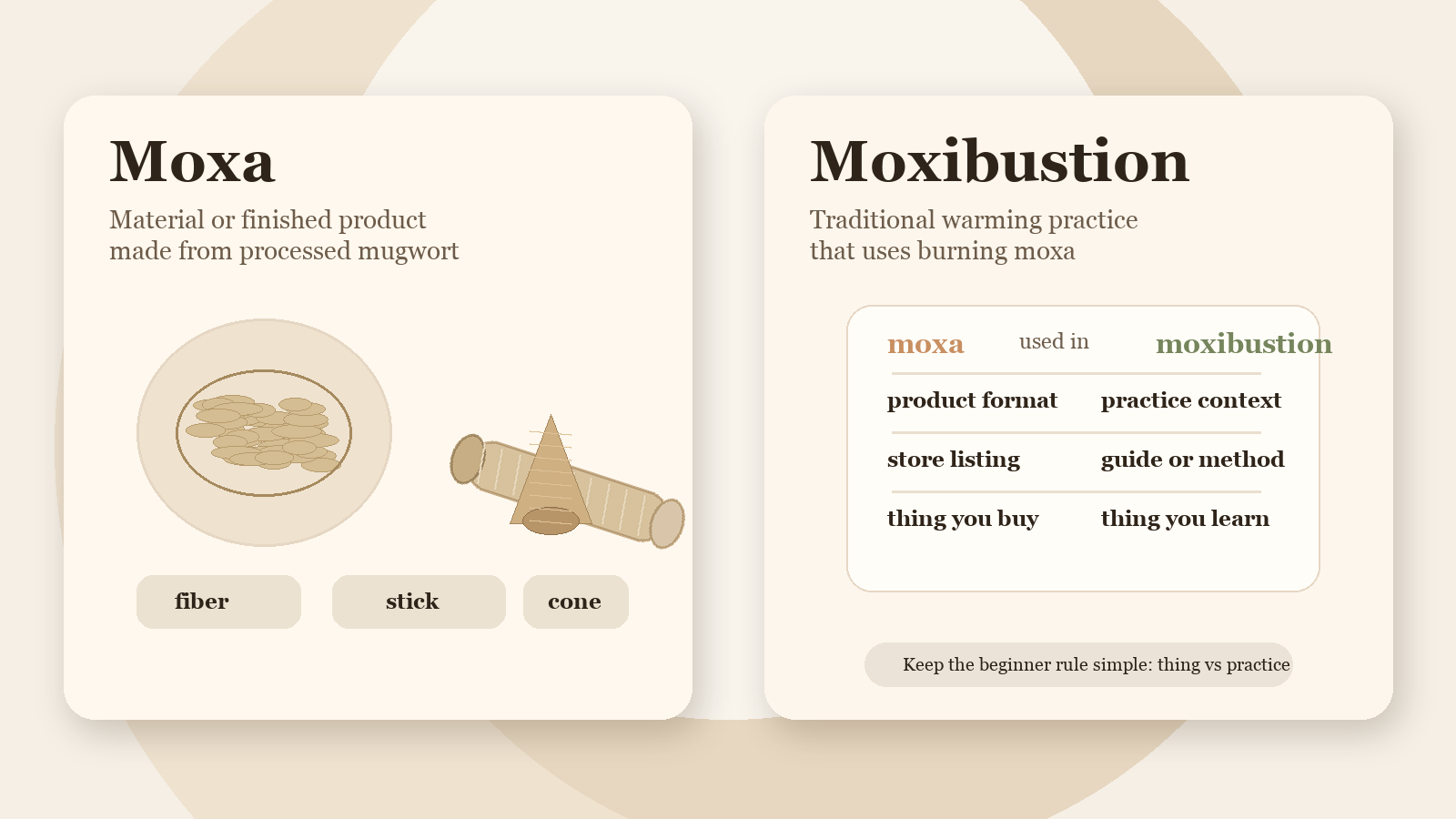
Moxa usually refers to the processed mugwort material or finished product, such as loose moxa wool, a cone, or a stick. Moxibustion refers to the broader traditional practice of using burning moxa to provide warmth. For beginners, separating the material from the practice makes product labels, safety advice, and basic guides much easier to understand.
Key takeaways
- Moxa usually names the material or finished product, while moxibustion names the practice that uses that material.
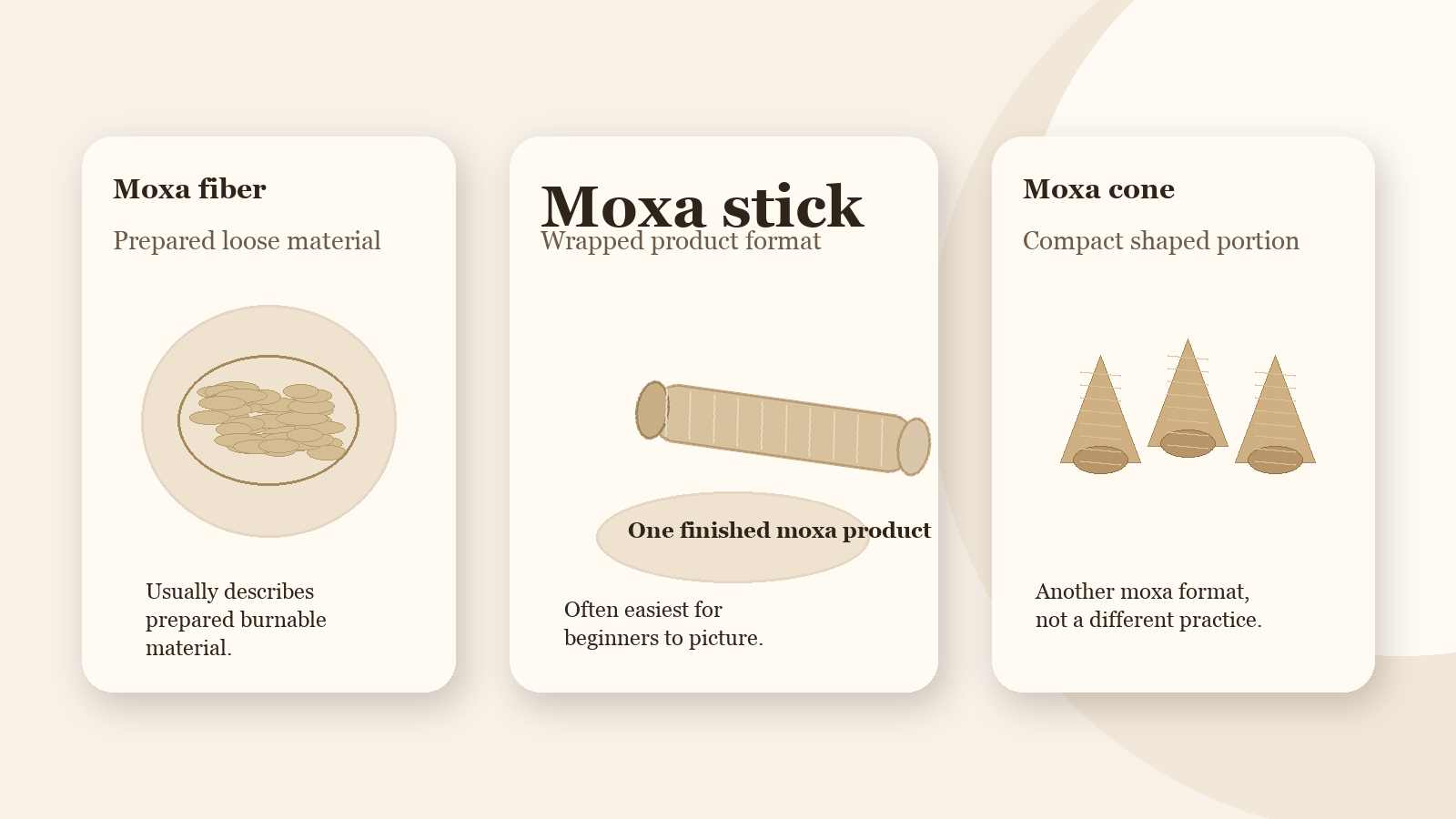
- A moxa stick, moxa cone, and loose moxa wool are different formats within the wider moxa category.
- Understanding the vocabulary helps beginners read product pages and safety guides more clearly before they try home use.
If you are new to the topic, the simplest distinction is this: moxa usually means the prepared mugwort material or a finished product made from it, while moxibustion means the traditional practice that uses burning moxa for warmth.
That difference sounds small, but it clears up a lot of beginner confusion. People often read a product page, a glossary article, and a safety guide in the same session. If every source swaps the words casually, it becomes hard to tell whether it is talking about the plant-based material, the product in your hand, or the broader traditional practice.
Why the terms get mixed up
The two words stay close because they belong to the same subject. If a page explains a moxa stick, it will usually mention moxibustion. If a page explains moxibustion, it will usually mention moxa as the substance being burned.
That overlap is normal, but it helps to slow the sentence down:
- mugwort is the plant source commonly associated with moxa,
- moxa is the prepared material or finished product,
- moxibustion is the traditional warming practice that uses burning moxa.
Once you see those as three related but different layers, product language becomes easier to decode. You can read “moxa wool,” “moxa stick,” and “moxibustion guide” without assuming they all mean exactly the same thing.
What “moxa” usually refers to
In beginner-friendly English, moxa is often used in two slightly different ways. Sometimes it means the processed fiber itself, such as loose moxa wool. Other times it means a finished product made from that material, such as a cone or stick.
That is why the word can feel broad. Depending on context, “moxa” might point to:
- the prepared burnable material,
- a product format made from that material,
- the general moxa category in a shop or article archive.
For example, someone might say, “This store sells moxa,” even if the catalog really contains sticks, cones, holders, and related accessories. In that sentence, moxa is acting as an umbrella term.
If you want a product-level definition, start with what is a moxa stick and what is mugwort used for in moxa.
What “moxibustion” refers to
Moxibustion refers to the traditional practice rather than to one specific product. The practice may involve different formats of moxa and different handling methods, but the core idea is that prepared moxa is burned to create warmth in a traditional Chinese medicine context.
That means moxibustion is the larger category word when you are talking about:
- the tradition or history,
- the method or routine,
- the safety context,
- the difference from acupuncture,
- the broader learning topic.
An easy comparison is this: flour and baking are connected, but flour is not the same thing as baking. In the same way, moxa and moxibustion are connected, but they are not interchangeable in the most precise sense.
A practical example for beginners
Imagine you are reading three different pages:
- A shop page says a stick is made from processed mugwort.
- A glossary page says moxibustion is a traditional warming practice.
- A safety page says home users should think about ventilation, ash, and distance from skin.
All three pages are about the same world, but they are not answering the same question.
The shop page is mostly talking about moxa as product material.
The glossary page is mostly talking about moxibustion as a practice.
The safety page is talking about what happens when a moxa product is actually used in a moxibustion setting.
Once you separate those jobs, the vocabulary becomes less intimidating.
Why this distinction matters before home use
For beginners, this is more than a language exercise. It affects how you research and how you buy.
If you search “What is moxa?” you are usually looking for material or product vocabulary. If you search “What is moxibustion?” you are usually looking for the broader traditional context. If you search “How to use moxa sticks at home,” you are moving into practical safety and handling questions.
Those are different stages of learning, and they should not be collapsed into one vague idea. A person can understand what moxa is without being ready to use it. In the same way, a person can read about moxibustion as a cultural or traditional practice without assuming every product is suitable for casual home use.
That is why beginner research should move in order:
- learn the vocabulary,
- identify the product format,
- understand the smoke, heat, and ash realities,
- review safety guidance before trying anything at home.
If you are at that third or fourth stage, continue with what is moxibustion, how to use moxa sticks at home, and moxibustion safety basics.
The short version to remember
If you only want one line to keep in mind, use this one:
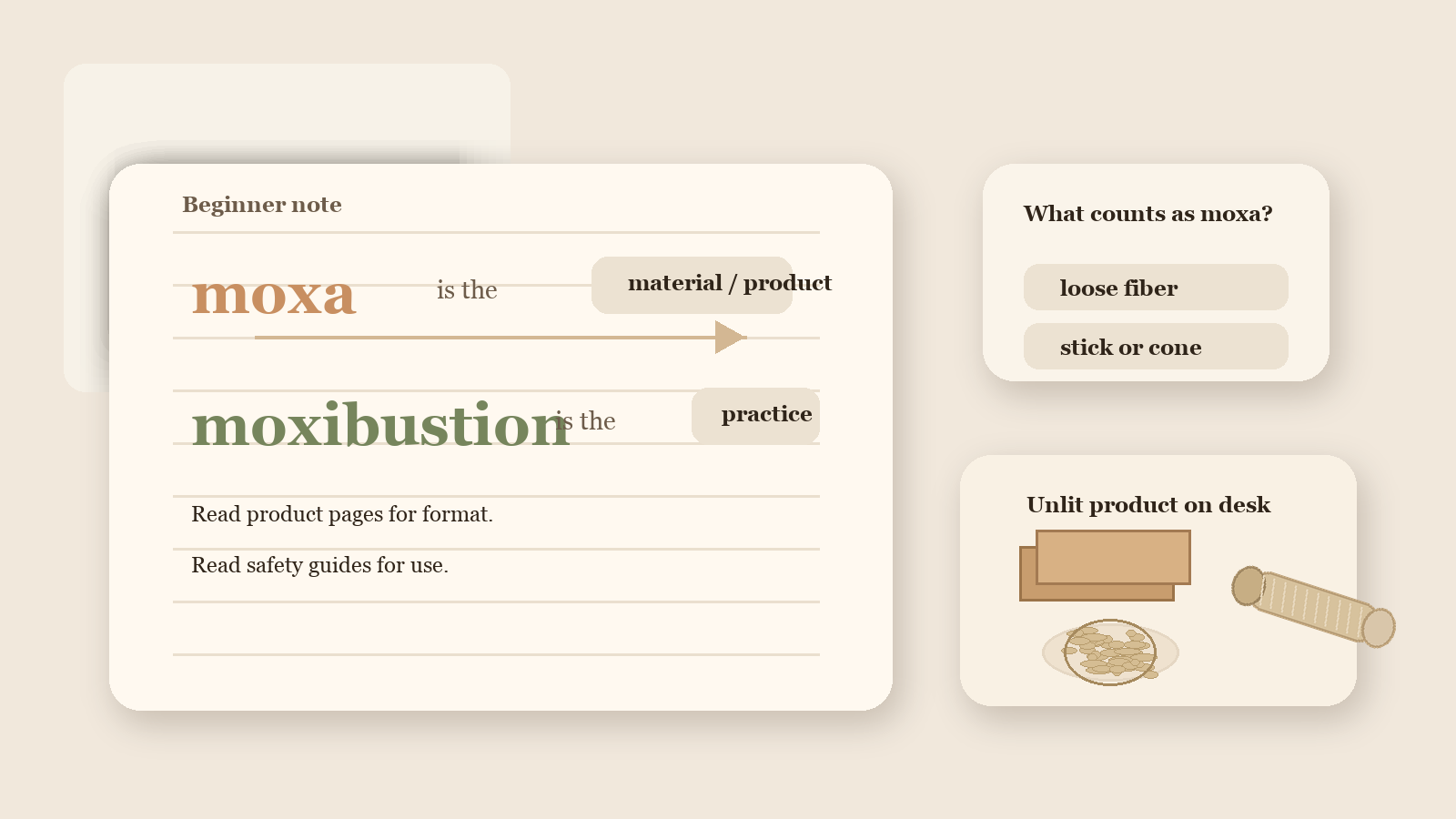
Moxa is the material or product. Moxibustion is the practice.
That is not the only way the words appear in real life, but it is the most useful beginner rule. It keeps you oriented when you read labels, compare product formats, or decide which article to open next.
Sources and further reading
- NCCIH: Traditional Chinese Medicine: What You Need To Know
- Britannica: Moxibustion
- Britannica: History of medicine in China
- PubMed: Safety of moxibustion: a systematic review of case reports
Common questions
Is moxa the same as moxibustion?
No. Moxa usually means the prepared material or finished item, while moxibustion is the traditional practice of using burning moxa for warmth.
Can a moxa stick be called moxa?
Yes. In everyday beginner language, a moxa stick is one type of moxa product. The broader word still covers other formats such as cones and loose moxa wool.
Why do product pages and articles mix the terms?
Because the words are closely related and often appear together. Sellers may describe the material, the product format, and the practice in one paragraph, which can blur the distinction for beginners.